Author: nctenantsstage_9aawhe

  • NCTU files lawsuit against HUD to preserve 30-day rule

    NCTU files lawsuit against HUD to preserve 30-day rule

    On February 26 the U.S. Department of Housing and Urban Development issued an Interim Final Rule rescinding the 2024 30-Day Notice protection for tenants facing eviction for nonpayment of rent. This rule required landlords in certain HUD-assisted properties to give tenants at least 30 days’ notice before filing for eviction and to provide a clear ledger along with information about how to seek a rent reduction if their income dropped.

    Now HUD is trying to roll that protection back..

    The North Carolina Tenants Union, alongside Jane Addams Senior Caucus, Maryland Legal Aid, and tenant leader Lisa A. Sadler, has filed suit in federal court to stop this rollback. The case argues that HUD cannot strip away a lifeline for millions of poor and working-class tenants without following the law and without considering the devastating harm it will cause.

    Why the 30-Day Rule Is a Lifeline

    For tenants in public and HUD-assisted housing, 30 days is not a technical detail. It is often the difference between stability and homelessness. Many tenants rely on fixed incomes such as Social Security that arrive later in the month. Others experience sudden medical expenses, administrative errors, or delays in public benefits. The 30-day notice period provides time to correct accounting mistakes, secure emergency rental assistance, complete income recertifications to lower rent, and access legal help.

    Without this protection, tenants in some states could face eviction after as little as 10 to 14 days, and in certain cases for being one day late or just one dollar short. That kind of accelerated timeline does not create accountability. It creates instability and unnecessary displacement.

    This Rollback Comes During a Housing Crisis

    Nearly half of HUD-assisted households are headed by seniors, and almost a quarter include a person with a disability. An eviction can mean homelessness, loss of access to medical care, and a permanent record that makes it much harder to secure future housing. For families with children, it often means school disruption and long-term harm.

    At a time when rents remain high and affordable units are scarce, weakening tenant protections will only deepen instability for communities that are already stretched thin.

    Tenants Are Organizing and Pushing Back

    Tenants are not remaining silent. Our members are organizing, documenting abuses, and stepping forward to defend their right to remain housed.

    In the legal filing, we shared testimony from a 71-year-old NCTU member in Winston-Salem who receives her Social Security income on the fourth Wednesday of each month, after her rent is due. Because of that timing alone, she receives eviction notices regularly. The 30-day rule has allowed her to cure any alleged nonpayment and remain in her home.

    Without that protection, she would likely be evicted not because she refuses to pay rent, but because of how the federal government schedules benefit payments. Her experience reflects a broader pattern in which tenants are penalized for administrative mistakes, rents are not adjusted quickly when income drops, late fees accumulate, and housing authorities move quickly to file eviction cases.

    This lawsuit is part of a broader pushback against increasing hostility toward tenants who rely on public housing. Tenants are building collective power to demand stability, fairness, and due process.

    HUD Must Follow the Law

    HUD attempted to bypass a full public comment process before implementing this rollback. That means tenants whose lives are directly affected were denied a meaningful opportunity to weigh in.

    The lawsuit asks the court to delay implementation of the rescission and preserve the 30-Day Notice rule while the case proceeds. Federal agencies are required to follow rulemaking procedures, especially when their decisions have life-altering consequences for millions of people.

    Housing Stability Is Nonnegotiable

    The 30-Day Notice rule does not prevent eviction in cases of long-term nonpayment. It ensures that tenants have a fair chance to understand what they owe, correct errors, and catch up before losing their homes.

    The North Carolina Tenants Union believes tenants should not be one administrative mistake, one medical emergency, or one delayed check away from homelessness.

    We are fighting in court. We are organizing in our communities. And we are making it clear that tenants will continue pushing back against policies that destabilize our homes and our lives.

  • Crystal Towers Tenants Demand Binding Protections Amid Potential Sale

    Crystal Towers Tenants Demand Binding Protections Amid Potential Sale

    The Crystal Towers United tenant association has formally submitted a demand letter to its landlord, ASPIRE, calling for binding, legally enforceable protections for residents in the event of any sale or redevelopment of the Crystal Towers public housing complex. More than half of all Crystal Towers households have signed on to the letter, reflecting widespread opposition to displacement and housing instability.

    Because ASPIRE has failed to commit to tenant protections, Crystal Towers United organized a press event on February 20 in which residents detailed the history of ASPIRE’s negligence and the dangers in fast-tracking a sale that could displace dozens of low-income residents.

    ASPIRE, formerly the Housing Authority of Winston-Salem, has been exploring the sale of Crystal Towers into private ownership. Tenants warn that without firm commitments, a sale could impact dozens of residents who rely on affordable rent and stable housing.

    “This is my home and I don’t want anything to change,” said resident Lisa Carroll. “I like that I can afford my rent. I don’t want to be on the streets. It can mess with your mental and physical health.”

    Tenants report that while exploring a sale, ASPIRE has overseen months of intimidation and disruption of tenant organizing, including efforts to dissolve a democratically elected tenant council and restricting access to common spaces needed for residents to communicate and advocate for themselves.

    “Management got what they wanted,” noted resident Douglas Summers. “Now they have a group of people that won’t hold them accountable.” 

    In their demand letter, tenants make clear that any sale or redevelopment of Crystal Towers must proceed only if residents are fully protected. Their demands include:

    • No increase in housing costs, with utilities and fees remaining included in rent
    • A guaranteed right for every resident to return to Crystal Towers after redevelopment
    • Comprehensive moving assistance, with additional support for disabled residents
    • A guarantee that no resident is moved without a confirmed, safe place to live
    • A transparent relocation process overseen by residents, with binding agreements to prevent displacement
    • A commitment to rebuild Crystal Towers with the same number and size of affordable units
    • Maintenance of safe, habitable living conditions up until the final resident relocation
    • Full resident education, engagement, and oversight throughout the sale and redevelopment process, free from intimidation


    To ensure these protections are enforceable, tenants are demanding that the tenant association be included as a party in any contract between ASPIRE and a prospective developer.”I feel as though ASPIRE does not care about the residents in Crystal Towers,” said resident Denise York. “They have not put forth the effort to come and sit down, and actually tell us from beginning to end what’s going on with the sale of the building. Nor have they done anything in the three years that I have been here for any repairs. No one from ASPIRE is telling us what’s going on.”

    Friday’s CTU press event shared resident stories and once again publicly called on ASPIRE, city officials, and community stakeholders to respect tenants’ rights and ensure that redevelopment, if it occurs, strengthens affordable housing rather than erasing it.

  • Evergreen Ridge Residents Go Public With Massive Mold Complaint

    Evergreen Ridge Residents Go Public With Massive Mold Complaint

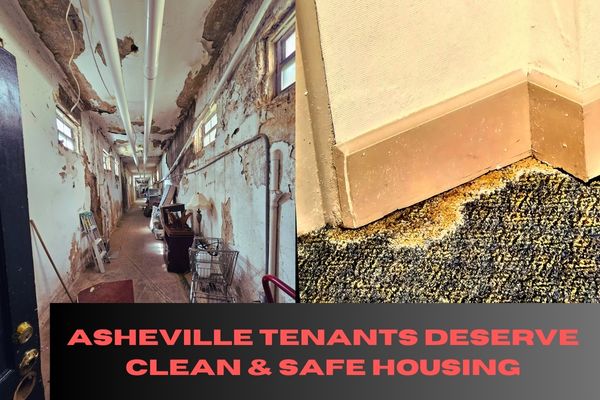
    Tenants at Evergreen Ridge Apartments are going public with concerns about the mold infestation and many other health and safety issues at the Asheville complex. The news coverage has published as tenant organizers with the Asheville Area Tenant Union have been knocking doors and making connections so that residents dealing with the conditions can join together to stand up for their rights and dignity.

    Evergreen Ridge is one of several complexes in Western NC that now have visible mold infestation problems following Hurricane Helene and its devastating floodwaters. It is a particularly difficult problem in jurisdictions like Asheville, where housing code does not regulate mold.

    Blue Ridge Public Radio published several interviews with Evergreen residents, including AATU member “Dana” (an alias to protect her from potential retaliation). Dana has been dealing with constant sinus congestion, one of many symptoms people can experience when they are regularly breathing in mold spores.The situation at Evergreen is made worse by unresponsive maintenance and amenities services, where residents have waited years for basic repairs, including for broken air conditioning and flooded carpets.

    AATU has been growing ranks and focusing on places like Evergreen, which lures tenants in with below-market pricing and leaves them in nearly uninhabitable conditions. Landlords like these are benefiting from a housing crisis following storms like Helene, which took many residences out of the housing pool.The BPR article was published soon after the car fire incident at Evergreen Ridge which destroyed AATU lead organizer Jen Hampton’s vehicle and which itself followed attempts of intimidation by maintenance staff. Despite this tense environment, tenants are still making their situation known and increasing the public scrutiny on the health problems presented by Evergreen’s mismanagement. A public safety fund set up to support tenants organizing in Asheville is still collecting donations and has worked to replace damaged property for Jen Hampton.

  • Crystal Towers and Healy Towers Tenants Take Stand As ASPIRE Ramps Up Retaliation

    Crystal Towers and Healy Towers Tenants Take Stand As ASPIRE Ramps Up Retaliation

    Tenants organizing with Housing Justice Now in Winston-Salem are calling on the city’s public housing authority to ramp down hostility toward organized tenants who have held them accountable. Amidst discussion of a possible sale of public housing, tenants have had some productive discussion with the landlord, but still need answers about halting retaliation, including threats of eviction for a tenant leader.

    Union members at Crystal Towers and Healy Towers, properties managed by ASPIRE (formerly the Housing Authority of Winston Salem), have spent the past few years confronting a system that has left residents living in substandard conditions. The collective action of organized tenants has led to many wins, including needed changes in the housing authority’s leadership.

    ASPIRE, however, has a long history of retaliating against residents with a pattern of intimidation that has severely ramped up in the last month. This coincides with two developments: Healy Towers tenants escalating their campaign to demand the removal of an abusive maintenance supervisor and ASPIRE announcing that they are exploring selling Crystal Towers.

    In the last month alone, ASPIRE has prevented residents from meeting in common areas, threatened invited external organizers with bans from the property, dissolved the Crystal Towers Resident Council, and initiated eviction proceedings that are clearly retaliatory against Ms. Edith Chisholm, a core leader at Healy Towers. These actions are transparently illegal and violate residents’ civil rights. In particular, the dissolution of the Crystal Towers Resident Council seems strategically timed and is leading to fears that ASPIRE plans to hand-pick residents for that Council who will not stand in the way of ASPIRE’s plans to sell the building.

    In response, the North Carolina Tenants Union has sent a legal request for actions remediating the intimidation tactics. Housing Justice Now, NCTU’s local in Winston-Salem, is demanding that ASPIRE retract the eviction notice delivered to Edith Chisholm, delay the process of electing a new Crystal Towers Resident Council until a third-party observer can be brought in to evaluate current conditions and ensure that an election is conducted without interference, and take additional steps to protect residents’ rights to organize.

    Discussions with ASPIRE leadership have resulted in some assurances. The housing authority says residents should still have access to their common spaces for the purposes of organizing with their neighbors, as well as allowing guests into the building for the purposes of supporting union activity. ASPIRE Executive Director Ted Ortiviz says he wants it to be “abundantly clear that ASPIRE will not ever, under any circumstances, retaliate against residents or organizers for engaging in protected activity.”

    HJN is still waiting for a commitment to retract the eviction threat sent to Ms. Edith, although there has been a promise to review the case. Dropping the retaliatory eviction against Ms. Edith is non-negotiable. Tenants cannot be forced to live in fear of speaking up for themselves and their neighbors. While reviewing the eviction filing is a step in the right direction, Winston-Salem tenants will continue to hold ASPIRE accountable and fight to ensure that Ms. Edith and every tenant of ASPIRE can freely exercise their rights

    Following weeks of attempts to chill union activity, tenants are responding with a show of solidarity. At Healy Towers, residents are placing Healy Towers United stickers on their doors to show they cannot be silenced or pushed out without a fight. On Thursday, Crystal Towers United leaders covered every floor of their building in flyers aimed at educating residents about their rights to organize.

  • Triangle Tenant Union Wins Tenant Defense ordinance in Durham

    Triangle Tenant Union Wins Tenant Defense ordinance in Durham

    Tenants claimed a major victory Monday as the Durham City Council unanimously voted in favor of a new ordinance that would criminalize the collection of rent by landlords overseeing dangerous and unlivable conditions. TTU members have been working for several months to secure this ordinance; attending multiple work sessions, gathering stories from their neighbors, driving a city-wide petition drive, and ultimately filling the council’s chambers to show the depth of community support. 

    Per the new ordinance, landlords can be charged with a misdemeanor if they collect rent on housing that has immediately dangerous conditions; rotted or damaged structural supports, unsafe wiring, unsafe roofs, no potable water supply, no operating heating equipment in cold months, no operable sanitary facilities, severe pest infestation, no safe or unobstructed exits on ground levels, among other violations. The language of the policy was first crafted by the Riverside High School Affordable Housing Club over the course of the past year. TTU members are thrilled to have supported these young people’s efforts and ensure the passage of this critical ordinance. 

    More than 20 speakers backed by a supportive crowd mobilized by TTU approached the City Council on Monday, sharing their experience with unsafe and undignified housing conditions imposed by landlords with long track records of neglect. The show of force by Durham tenants made it clear during council deliberation that the citizenry would not support changes to the measure that would weaken a tenant’s ability to leverage city code when confronting landlords. 


    My fridge has been broken for months. I asked my landlord to fix it, replace it, to do his job. Instead, I was forced to spend my own money to buy a new refrigerator to store my insulin. That expense left me behind on rent and now my landlord is trying to evict me because I had to do his job for him.” Says Ms. Brenda Solomon, a TTU Tenant Leader, “We need this ordinance so tenants like me don’t face the consequences for our landlord’s failures” 

    Despite vocal opposition from the landlord industry lobbyists, the Triangle Apartment Association and from the Realtors Association, tenant and people power prevailed.  After more than three hours of comment and discussion, the ordinance was approved in its original, most effective form.

    I have been without heat now for a week, due to their negligence”, Said Vincent Lawrence a TTU member and resident of Willard St. Apartments, “I’ve called, I’ve left messages, they won’t even call me back. I am a senior and disabled – This is not right.  The City Council needs to support this (ordinance)  because this will give a voice to us.”

    Before this ordinance passed, tenants suing their landlords to get back rent and necessary repairs were required to jump through complex legal hoops to argue about the precise amount of abatement, or back rent, they were owed. This ordinance makes it clear: unlivable means unlivable. Now, these conditions mean that the landlord owes them back 100% of their rent.

    This measure will be an invaluable tool for tenants organizing with their neighbors to win repairs. If landlords are unlawfully collecting rent on dangerous units, they could be charged with a misdemeanor each time. When tenants face eviction for non-payment from units with these dangerous conditions, this ordinance means that their full rent should be refunded. When the amount owed back to a tenant is more than the amount owed, tenants almost always win their eviction case.

    ORDINANCE “GIVES US A LEGAL TOOL TO FIGHT BACK AND TO LIVE WITH BASIC DIGNITY”

    In their fight for better policy, tenants working with TTU have shared their experiences dealing with landlords who see them as mere numbers or even obstacles for further profit. 

    This ordinance is a shield for our most vulnerable neighbors. It’s for the elderly residents living with black mold who are too afraid to complain for fear of a retaliatory eviction. It’s for my undocumented neighbors, enduring severe pest infestations because their landlord counts on their silence.”  Said Brianda Barrera, a TTU tenant leader and public health professional  “This ordinance gives us a legal tool to fight back and to live with the basic dignity everyone deserves.” 


    Tenants who spoke at preceding Durham City Council work sessions noted that landlords across the city take advantage of a permissive environment to abuse marginalized tenants with few housing options. In a housing market where more than 50 percent of Durham tenants are considered rent burdened based on income, landlords pursuing a gentrification strategy have slow-walked maintenance of properties lacking basic amenities and imposing multiple safety hazards. The intent is to maximize profit by minimizing maintenance costs and often for tenants to break their leases in desperation or to otherwise be pushed out after conflict with staff while trying to fix dangerous conditions. Additionally, many of Durham’s immigrant population with language barriers find themselves in unsafe housing with increasing pressure to stay put and tolerate the conditions.

    The ordinance evokes similar motions passed in Charlotte, Pinesville, and Pittsboro, bringing Durham one step closer to a basic standard of pro-tenant policies that center every day citizens over the demands of property owners that have priced regular, working families. 
    In my public health career, I’ve learned two fundamental truths: First, that housing is a human right. And second, that housing is healthcare,” said Barrera. “The quality of our housing is one of the most impactful social determinants of health. A person cannot manage diabetes in a home with no running water. A child cannot overcome asthma in an apartment with black mold and a pest infestation. And no one can heal when they are shivering in a home with no heat in the winter.

    Triangle Tenant Union will start training tenants on how to leverage the new ordinance to advocate for themselves and will continue its ongoing work of organizing with tenants to demand their dignity and the full value of their hard-earned rent.

  • Standing With Organizers After Incident at Evergreen Ridge Apartments

    Standing With Organizers After Incident at Evergreen Ridge Apartments

    On Saturday, October 11, while canvassing with residents at Evergreen Ridge Apartments in Asheville, the car of Asheville Area Tenants Union (AATU) Lead Organizer Jen Hampton was set on fire and completely destroyed. Jen was on site to support tenants who have been raising concerns about mold and other serious problems in the building.

    The investigation is still underway, and not all details are known. But here is what we do know:

    • During earlier canvassing efforts, a maintenance worker verbally threatened Jen and other volunteers. On October 4, he warned canvassers that the next time they saw him, it would be “in a black ski mask.”
    • That same maintenance worker appeared to photograph Jen’s vehicle and was seen near the car on the day it was burned.

    Incidents like this underscore why tenant organizing is so critical, and why communities must stand together against retaliation. Here are two ways you can take action right now:

    1. Support Organizer Safety and Recovery

    AATU has launched a fund to support safety and recovery for organizers who face harm while standing with tenants. The first priority is helping our organizer whose car was destroyed in what appears to be retaliation for tenant advocacy.
    Please consider donating to help Jen recover.
    → Donate to Fund

    2. Stand With Evergreen Ridge Tenants

    Residents of Evergreen Ridge are calling on their landlord to sign a binding agreement protecting them from retaliation as they advocate for safe and healthy housing.
    Add your name to the petition and show that tenants are not alone.
    → Sign Petition

    Tenants need clear, enforceable protections—now more than ever—to ensure that organizing for safe living conditions is not met with intimidation or violence.

    If you believe tenants should be able to speak up without fear, we invite you to become a recurring supporter of AATU’s work. Steady monthly support strengthens our ability to respond quickly to threats, provide emergency resources like temporary relocation or lock changes, and remain present with tenants for as long as it takes to secure their safety.

    Together, we can ensure that every tenant has the power—and the protection—to demand the homes they deserve.

  • Camelot Village Tenants Fight For Housing After Tropical Storm Chantal

    Camelot Village Tenants Fight For Housing After Tropical Storm Chantal

    More than a month after Tropical Storm Chantal displaced dozens of Camelot Village residents in Chapel Hill, several are still left without safe and affordable housing options as they approach a deadline to leave accommodations set up by local government.

    In a bid to compel landlords and local government officials to respond to basic tenant rights, six Camelot Village residents stepped forward this week to tell their individual and collective stories. Triangle Tenant Union, in partnership with Triangle Mutual Aid, helped set up a press conference event on Wednesday so these tenants could speak to media outlets about a variety of ongoing issues, including withheld rent and security deposits, mounting application fees for new apartments, and a general state of neglect at Camelot Village, which has seen increasingly destructive incidences of catastrophic flooding.

    Despite invites sent to Mayor Jess Anderson and every town council member, only one local government representative, Jamezetta Bedford, the chairwoman of the Orange County Board of County Commissioners, was in attendance. However, the event was attended and reported on by several local news outlets, including NC Newsline, the News & Observer, and Chapelboro/The Hill.


    If You Say No to the Process, You are Put Out on the Street.”
     

    Heather Gibbs is one of multiple tenants who have not seen their July rent pro-rated for the amount of time it has been uninhabitable. She has already spent more than $300 in application fees searching for new housing. “What we have received from Red Cross – that’s been burned up almost instantaneously because of application fees and getting basic necessity items,” she said.

    Heather had been at Camelot Village since April through use of her Section 8 housing vouchers. “Camelot was the only affordable housing that I was able to be placed in. I was not made aware of the flooding situation until the time of signing my lease and at that point I could not back out because of how the system works with people that are on county funding. If you say no to something in the process, then you are put out on the street.”

    The challenges of the voucher system have delayed Heather’s ability to move on from temporary housing. “One complex that I applied at wasn’t passing the inspections and they weren’t getting the apartment ready. So then I applied at another place and I’m in the waiting process again, waiting for paperwork and waiting for inspection.” These same fees that have absorbed much of the meager assistance are non-refundable even when it’s the landlord who won’t pass inspection for voucher-users.
     
    Jessica Tickles lived at Camelot Village for seven months and has already seen two floods impact her housing. “I’m still fighting my landlord to give me my deposit back. A lot of places are not giving deposits back.” Discussing her options, Jessica said that she was in danger of being unhoused when Chapel Hill and Orange County’s housing assistance expires. “I haven’t found any place that I can  afford. I had to take off work to find housing. I’m restarting back to work and it’s like starting from zero again.” Jessica noted that the situation is also un-navigable for people who need affordable housing, but who haven’t been enrolled in a Section 8 program.

    Joyce Lester has been at Camelot for nearly five years and has seen three flooding incidents. “Most of the places” she’s been able to look at “want three times or four times the rent” that she was paying already.

    “Without my neighbors, I wouldn’t have made it out.”
     

    Faced with the sudden rise of Bolin Creek’s floodwaters, several residents were helped to safety by their neighbors, including Joyce and Heather. Heather relies on a mobility aid and was assisted by neighbors who knew she would need help. “They went around three or four other places where they knew other people” that could not have escaped on their own. “I would not have made it out had they not come in. There was nobody else there.”

    Dale Weldele stressed how the situation became dangerous within twenty minutes. “If it wasn’t for the neighbors who were able to rescue me, I wouldn’t have made it out….My prosthetic came off in the current…By the grace of God, I made it there. [But I] lost everything.  I’m starting all over.” Dale is now also facing mounting application fees in search for an apartment that can accommodate his needs.

    Quinten Simmons has been there more than eight years and has seen multiple floods. He found himself in a precarious situation as a wheelchair user. “I was actually in the water,” he said. “If it wasn’t for the fire department and my friend keeping me alive, I would have died in that apartment.” Discussing the continual flooding issues, Quentin said, “That place is a death trap.”
     

    It’s Going to Happen Again”

    Camilla Hackney has seen three floods in three and a half years. After the first flood, she said Camelot’s landlords and property managers “did nothing about it.” After a second flood, “They tore all our walls out and we still had to live inside. They tore out our toilets.” Camelot’s disposal methods also threw out many of her important family belongings.

    “This was really hard to go through,” Camilla said. “This was the worst one. And they’re just going to keep rebuilding there. It’s going to happen again.”

    Quenten also stressed the cyclical nature of the floods. “I’m not going back there,” he insisted. “I can’t go back there.”


    With People’s Help, Good Days Ahead”
     

    Amid the devastation, some of the residents are emphasizing gratitude toward community members who have provided assistance with food and mucking out flooded residences.

    “I just want to thank people in the organizations for the help they’ve given us, but we still have a long way to go. This experience was terrifying. I’m 62 years old and I’ve lost everything. But good days ahead with people’s help.”

    “We have supported each other through this.” Joyce said. “We have come together.”

    Community support and tenant solidarity have been vital in getting concessions from many of the landlords who own condominiums in Camelot Village. Triangle Tenant Union and organized tenants across the state continue to call on landlord holdouts to return to tenants what is rightfully theirs: the rent and deposits that are necessary to move forward from this traumatic event. Any tenant who has found a safer alternative to Camelot Village should not be locked into a lease agreement and should be provided with relocation assistance. 

    We also call on the Town of Chapel Hill and Orange County to acknowledge that these residents have not been given enough time to navigate a hostile housing market. Local government should extend financial assistance for temporary accommodations.

  • Winston-Salem Tenant Power Secures Fare-Free Buses During Climate Emergencies

    Winston-Salem Tenant Power Secures Fare-Free Buses During Climate Emergencies

    Last week, tenant power secured a vital resource for Winston-Salem’s transit users as Housing Justice Now and its partners secured fare-free bus service on days of excessive heat and dangerous cold. On Monday, August 4, Winston-Salem city council passed a motion to run buses without fare between the hours of 10 a.m. and 7 p.m. any day when the temperature reaches 95°F or the heat index reaches 100°F. Additionally, the item codified a policy where bus service would be free for any 4 hour timeframe when the windchill dips to 20°F or below.

    HJN’s demands of city government were organized from a rapid response team started in June in response to record-breaking temperatures and dangerous conditions during which Winston-Salem tenants and pedestrians were forced to give up bus fare in exchange for relief from oppressive heat. Next, tenants set up a petition drive, providing direct aid to bus riders and explaining why they were demanding free bus service during climate extremes. HJN also partnered with Piedmont Environmental Alliance, Winston-Salem Democratic Socialists of America, and Twin City Harm Reduction Collective to spread the word and call for signatures, gathering about 1,000 signatories.

    The petition for free bus fare was initially faced with stonewalling and delay. After tenants insisted on meeting with Mayor Allen Joines, they were told that it would be too late to adjust the budget for emergency climate response and that the cooling centers would be sufficient. So the union focused its efforts on a pressure campaign which the Mayor could not ignore. After hearing consistent feedback from the community fed up with excuses, Mayor Joines conceded that this could be done and Winston-Salem Transit Authority piloted fare-free extreme heat service from July 26 through July 30.

    The motion before City Council to provide free bus service for both extreme heat and extreme cold passed unanimously. It is one step toward what HJN and tenants across the state believe should be the norm: A fare-free transit city. It is also an example of the type of change we can see happen when our community members come together to demand basic dignity in the face of increased climate calamity and economic hardship. Work on the frontlines of modern challenges faced by NC tenants is only just beginning – however, we know we have the numbers to demand justice. HJN proved that this summer.

    If you would like to join the effort of organizing tenant communities across Winston-Salem and effecting change, you can get involved with Housing Justice Now and learn more here.